

Choosing the right tools for backend development can be a formidable task. The Node.js ecosystem is rich with powerful, efficient, and specialised frameworks, but selecting the perfect one for your project's specific requirements is crucial for success. Whether you are building a lightning-fast API, a real-time application, or a scalable enterprise-level service, the landscape of Node JS frameworks offers a tailored solution. This guide moves beyond simple lists, offering a detailed, practical analysis of the top frameworks and essential learning resources. We're here to help you navigate this complex environment effectively.
This resource provides a direct path to understanding the key players. We will explore their architectural philosophies, dissect practical use cases, weigh performance considerations, and honestly assess their potential limitations. Each entry is designed to be scannable and includes direct links to official documentation and repositories, helping you make an informed decision and accelerate your development workflow. Our goal is to equip you with the knowledge needed to choose the framework that aligns perfectly with your technical goals, team expertise, and project scope. This breakdown cuts through the noise, focusing on what truly matters for developers in 2025.
1. npm
While not a framework itself, npm (Node Package Manager) is the indispensable starting point for any developer exploring Node js frameworks. It is the world's largest software registry, acting as the central hub where developers publish, discover, and install the building blocks of Node.js applications. Essentially, every framework discussed in this listicle is distributed and managed through npm, making proficiency with its platform a foundational skill.
The platform's core strength is its command-line interface (CLI), which is bundled with every Node.js installation. This integration allows for a seamless workflow to initialise projects, add frameworks like Express or NestJS, and manage countless other dependencies. Beyond its public registry, npm offers features for private packages and organisational tools, crucial for teams managing proprietary code.
Key Features & Considerations
- Vast Ecosystem: Access to millions of packages, from complete frameworks to single-purpose middleware.
- Integrated CLI: The
npm installcommand is the gateway to adding any framework to a project. - Security: Offers features like 2FA, token management, and security audits to help identify vulnerabilities in dependencies.
A practical tip for new users is to always check package download statistics, recent update history, and open issues on the npm website. While the registry is an unparalleled resource, vigilance is required to avoid abandoned or malicious packages.
Website: https://www.npmjs.com/
2. GitHub
GitHub is the canonical home for virtually all open-source Node js frameworks. It serves as the primary platform where framework source code is developed, managed, and shared. For any developer working with Node.js, GitHub is the source of truth for cloning starter projects, tracking release updates, reviewing changelogs, and participating in the development process through issues and pull requests.
More than just a code repository, GitHub is a collaborative ecosystem. Its features, like Discussions, Actions for CI/CD, and integrated security vulnerability scanning, are central to the modern development lifecycle. Beyond hosting code, GitHub also fosters growth in the open-source community through various initiatives; for instance, you can read about a relevant GitHub Accelerator experience to see how it supports key projects. This community aspect makes it an invaluable resource for finding examples and getting support.
Key Features & Considerations
- Source of Truth: Provides direct access to the latest framework code, pull requests, and official releases.
- Integrated Tooling: Features like Actions, Copilot for AI-assisted coding, and Discussions enrich the development workflow.
- Community Ecosystem: A vast network of developers contributing to frameworks, creating examples, and offering support.
A key practical tip is to always verify the publisher and check the repository's activity (stars, forks, recent commits) before using code. While GitHub is an essential tool, its open nature means users must remain vigilant against abandoned or potentially malicious repositories.
Website: https://github.com/
3. Express
Express.js is the quintessential minimalist web framework for Node.js, widely regarded as the de facto standard for building APIs and web applications. Its unopinionated nature provides a thin layer of fundamental web application features without obscuring Node.js features that developers know and love. This approach gives developers complete freedom to structure their applications, making it one of the most flexible and foundational node js frameworks available.
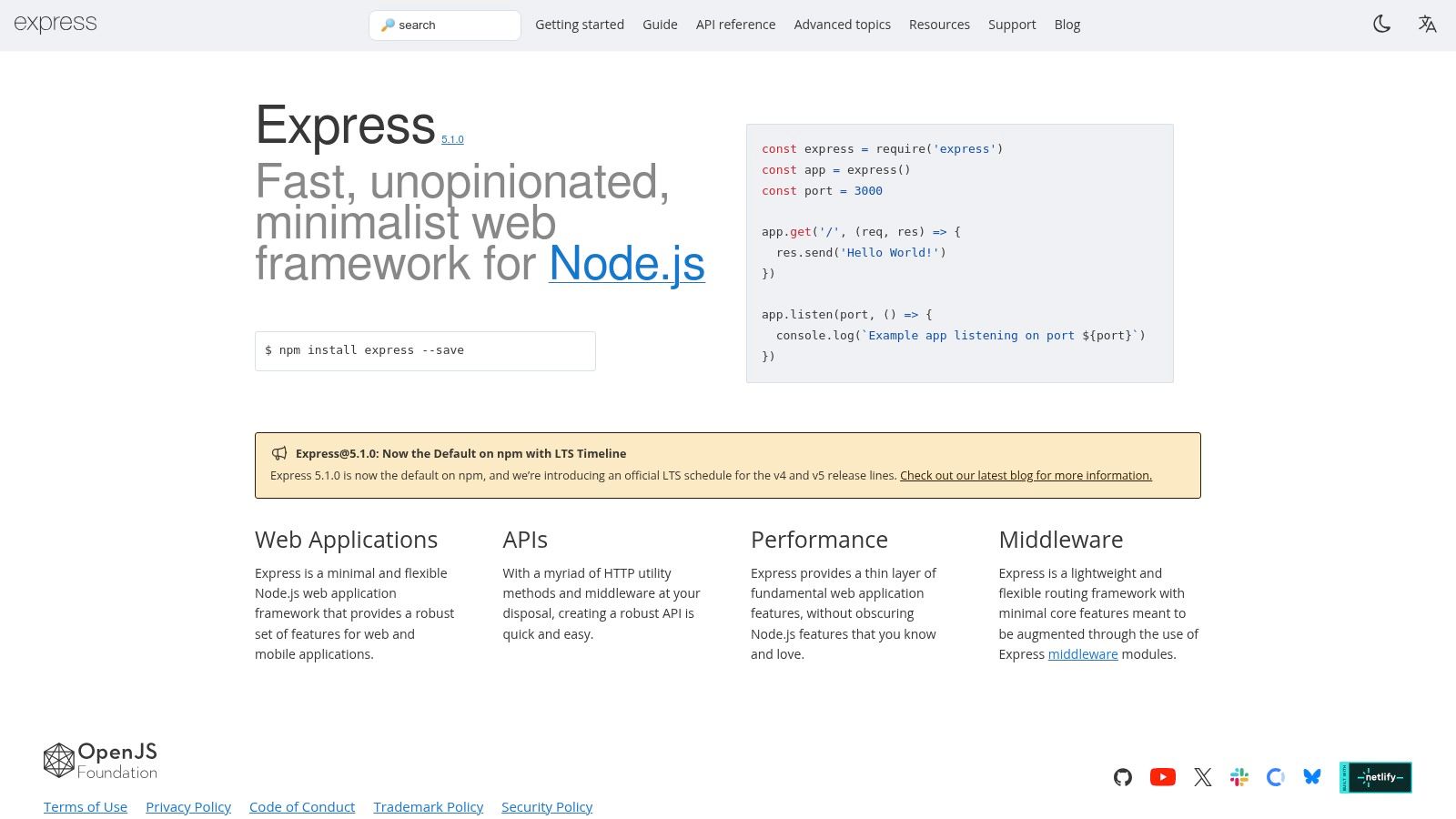
The framework's core strength lies in its robust routing system and its elegant use of middleware, which allows for the organisation of application logic into modular, reusable pieces. Because of its long-standing presence and massive community, the ecosystem of compatible middleware available via npm is unparalleled, offering solutions for almost any required functionality. This stability and extensive support make it an excellent choice for projects of all sizes, from small prototypes to large-scale enterprise systems.
Key Features & Considerations
- Robust Routing: A powerful API for defining routes to handle various HTTP requests.
- Middleware Ecosystem: A vast collection of middleware packages to add functionality like parsing, authentication, and logging.
- Template Engine Support: Easily integrates with popular template engines like Pug, EJS, and Handlebars for server-side rendering.
While its minimalism offers great flexibility, it also means developers must make more architectural decisions. Those seeking more structure out-of-the-box might explore other options, but for a stable and well-understood foundation, Express remains a top contender among the best web application frameworks.
Website: https://expressjs.com/
4. NestJS
For developers building scalable, enterprise-grade applications, NestJS stands out among Node js frameworks. It is a highly opinionated framework that heavily leverages TypeScript and borrows concepts from Angular, such as dependency injection and a modular architecture. This structure brings a level of organisation and predictability often required for large-scale projects, making it a powerful choice for building complex back-end systems.
NestJS is built on top of robust HTTP server frameworks like Express (the default) and can optionally be configured to use Fastify. This flexibility allows developers to start with a familiar foundation while benefiting from Nest's advanced architecture. Its command-line interface (CLI) streamlines project scaffolding and module creation, mirroring the developer experience found in front-end frameworks like Angular, which is a key part of an efficient software development life cycle.
Key Features & Considerations
- Modular Architecture: Enforces a strong, organised structure through modules and providers.
- TypeScript-First: Provides static typing out of the box, reducing errors and improving developer productivity.
- Built-in DI Container: Simplifies managing dependencies and enhances code testability and scalability.
- Platform Agnostic: Supports REST APIs, GraphQL, WebSockets, and microservices with first-class integrations.
The primary consideration is its learning curve. Developers unfamiliar with TypeScript or dependency injection patterns may need time to adapt. However, the comprehensive documentation and structured nature make it an excellent long-term investment for team-based, complex projects.
Website: https://nestjs.com/
5. Fastify
Fastify distinguishes itself as one of the most performance-focused Node js frameworks available, engineered to deliver the best possible throughput with minimal overhead. It is built for speed and efficiency, making it an excellent choice for developing highly performant APIs and microservices. The framework achieves its speed by using a schema-based approach, where developers define JSON Schemas for routes, which Fastify then uses to optimise and accelerate validation and serialisation processes.
The platform is designed around an extensible plugin architecture, allowing developers to add functionality without compromising the core's performance. Everything from authentication to database connectors is handled through plugins, ensuring a lean and modular application structure. This design philosophy not only boosts performance but also improves code organisation and maintainability, which is crucial for scalable projects. Its emphasis on performance aligns well with modern development practices; you can learn more about optimising your development pipeline on kpinfo.tech.
Key Features & Considerations
- High Performance: Claims to be one of the fastest Node.js web frameworks, processing thousands of requests per second.
- Schema-Based: Leverages JSON Schema for request validation and response serialisation, which significantly boosts performance.
- Extensive Plugins: A rich ecosystem of official and community-driven plugins for nearly any required functionality.
A practical tip when starting with Fastify is to embrace its plugin-centric model fully. Instead of building monolithic services, structure your application into encapsulated plugins. This approach not only leverages the framework’s strengths but also makes your code easier to test and reuse across different projects.
Website: https://fastify.dev/
6. Koa
Developed by the original creators of Express, Koa is a next-generation web framework for Node.js, designed to be smaller, more expressive, and more robust. It differentiates itself by leveraging ES2017 async/await syntax to eliminate callbacks and dramatically simplify error handling. This makes Koa an excellent choice among Node js frameworks for developers who prioritise modern JavaScript features and a clean, unopinionated foundation.

Unlike its predecessor, Koa's core is intentionally minimal, shipping without any bundled middleware. This philosophy gives developers complete control to assemble their application's stack precisely as needed, avoiding bloat. The framework's cascading middleware flow is more elegant and intuitive than traditional approaches, allowing for powerful features like content negotiation and redirection to be implemented cleanly. It is ideal for building high-performance APIs and web services where fine-grained control is paramount.
Key Features & Considerations
- Modern Asynchronous Flow: Built around
async/awaitfor cleaner, more readable, and easier-to-debug middleware. - Minimalist Core: Provides a very small footprint, forcing developers to be explicit about the features they include.
- Enhanced Error Handling: Utilises
try/catchblocks, offering a more familiar and robust error-handling mechanism.
A practical approach when starting with Koa is to identify essential middleware for your project early on, such as koa-router for routing and koa-bodyparser for request parsing. This deliberate setup process, while requiring more initial effort, results in a highly optimised and maintainable application.
Website: https://koajs.com/
7. AdonisJS
For developers who appreciate a "batteries-included" approach, AdonisJS is one of the most complete Node js frameworks available. It provides a highly organised and opinionated Model-View-Controller (MVC) architecture that feels similar to frameworks like Laravel or Ruby on Rails. This structure accelerates development by offering a cohesive ecosystem where core functionalities like an ORM, authentication, and validation are built-in and designed to work together seamlessly from the start.
AdonisJS is built with TypeScript first, providing excellent developer ergonomics and type safety out of the box. Its dedicated command-line tool, Ace, simplifies common tasks such as creating controllers, models, and database migrations. This focus on a streamlined workflow and first-party tooling makes it an excellent choice for building large-scale, maintainable back-end applications where consistency and rapid development are paramount.
Key Features & Considerations
- Integrated Tooling: Comes with Lucid (a powerful ORM), a robust authentication system, and a built-in validator.
- TypeScript-First: Designed from the ground up for TypeScript, offering superior autocompletion and error checking.
- Opinionated Structure: Provides a clear, pre-defined project structure that guides developers toward best practices.
The framework's opinionated nature can present a learning curve for those accustomed to more minimalist libraries. However, for teams that buy into its conventions, the payoff is a highly productive and consistent development experience across the entire project.
Website: https://adonisjs.com/
8. Sails.js
For developers coming from a Ruby on Rails background, Sails.js offers a familiar and highly productive environment within the ecosystem of node js frameworks. It is a real-time, Model-View-Controller (MVC) framework designed to emulate the conventional patterns of frameworks like Rails, making it excellent for building practical, production-ready Node.js apps quickly. Its philosophy is centred on convention over configuration, which drastically reduces boilerplate code.
Sails is particularly well-known for its data-agnostic nature, powered by the Waterline ORM. This allows an application to use any supported database without changing code. It also shines with its auto-generated REST APIs and robust support for WebSockets, enabling the development of real-time features like chat applications with minimal effort. This makes it a powerful choice for data-intensive projects that require a quick turnaround.
Key Features & Considerations
- Waterline ORM: A database-agnostic tool that provides a uniform API for accessing data from different database systems.
- Auto-generated REST APIs: Blueprints automatically create CRUD routes for your models, significantly speeding up API development.
- Built-in WebSocket Support: Integrates seamlessly with Socket.IO for building real-time, bi-directional communication applications.
While its high level of abstraction is great for rapid prototyping, developers who prefer granular control might find it too opinionated. However, for building enterprise-grade applications with complex data requirements, Sails.js provides a structured and efficient path.
Website: https://sailsjs.com/
9. Meteor
Meteor is a full-stack JavaScript platform for developing modern web and mobile applications. Among Node js frameworks, it stands out by providing an integrated solution that covers everything from the database to the user interface, with a strong emphasis on real-time capabilities. Its core philosophy is to simplify development by using JavaScript across the entire stack, enabling rapid prototyping and seamless client-server data synchronisation.
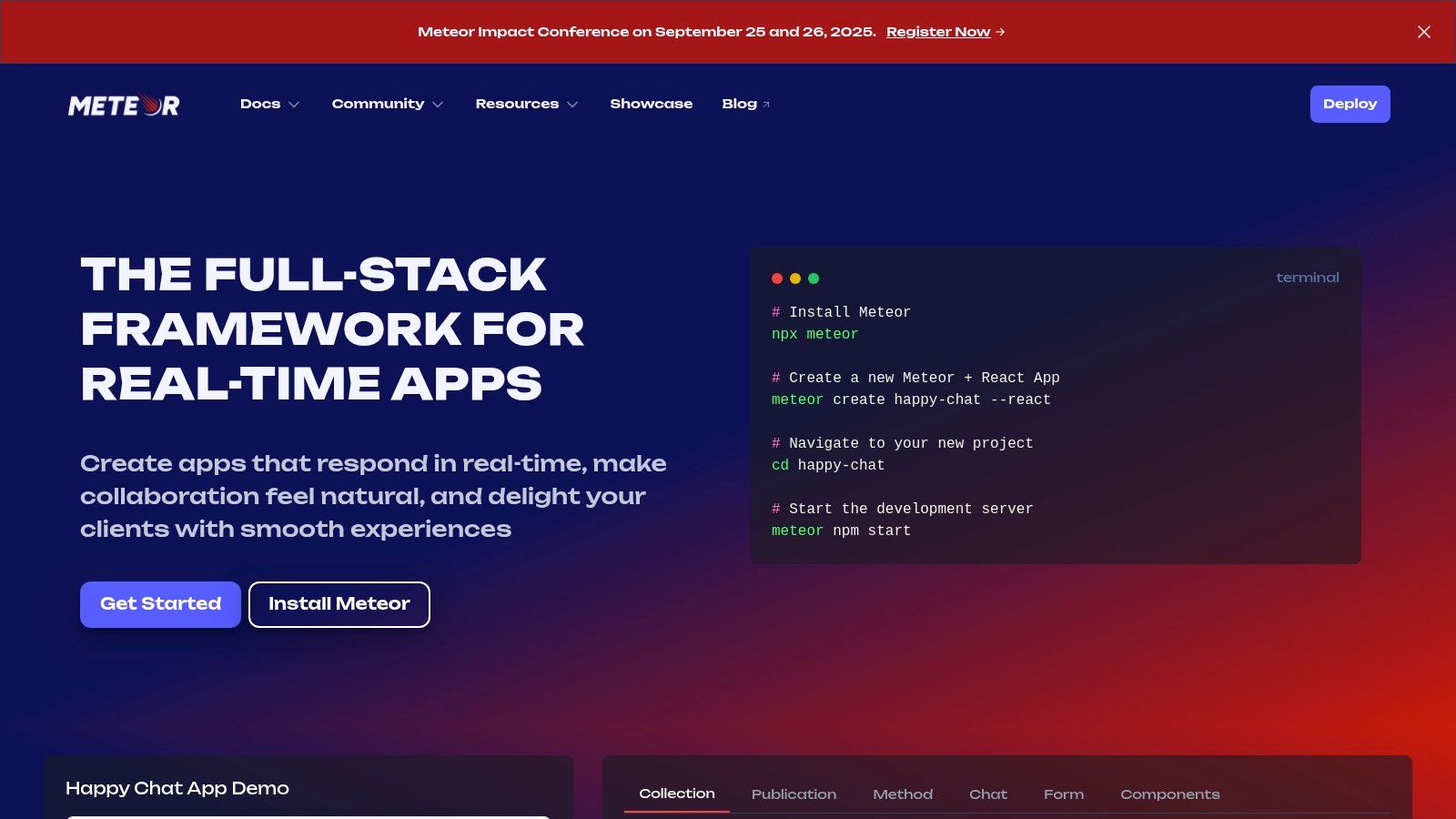
The framework's primary advantage is its Data on the Wire approach, where the server sends data, not HTML, and the client renders it. This is managed through its Distributed Data Protocol (DDP), which keeps data consistent between the client and server automatically. Meteor also offers a dedicated, fully-managed cloud hosting service called Galaxy, which is specifically optimised for Meteor applications, providing features like push-to-deploy, autoscaling, and performance monitoring.
Key Features & Considerations
- Integrated Stack: A complete, batteries-included platform with front-end, back-end, and database management in one environment.
- Real-Time by Default: Built-in support for live data updates, making it ideal for collaborative tools, live feeds, and real-time dashboards.
- Managed Hosting: Meteor Galaxy provides a seamless deployment and scaling solution, simplifying infrastructure management for development teams.
While its all-in-one nature is powerful for rapid development, it creates a more specialised ecosystem compared to modular frameworks like Express. This makes Meteor an excellent choice for projects that benefit from its opinionated structure, but potentially less flexible for highly customised architectures.
Website: https://www.meteor.com/
10. LoopBack
LoopBack is a highly extensible, open-source framework that excels at rapidly building dynamic REST and GraphQL APIs. It stands out among Node js frameworks by using a powerful model-driven approach, where developers define their data models, and LoopBack automatically generates a significant portion of the API boilerplate. This structure is ideal for projects that require complex data integrations and standardised endpoints from the outset.
The framework's core strength lies in its data source connectors, which allow seamless integration with various databases (like PostgreSQL and MongoDB) and other services (SOAP, REST). Its command-line interface (CLI) streamlines project scaffolding, model creation, and relationship management, making it an incredibly efficient tool for backend development. Backed by IBM, it offers robust documentation and a stable, enterprise-ready architecture.
Key Features & Considerations
- Model-Driven API Generation: Quickly create standardised CRUD endpoints directly from data models.
- Extensive Data Connectors: Connect to a wide array of SQL, NoSQL, and external service data sources with minimal configuration.
- Built-in Access Control: Features a robust Access Control List (ACL) system for defining granular user permissions and roles.
A practical consideration is that LoopBack’s opinionated, model-first workflow can feel heavy for very simple applications. However, for building complex microservices or enterprise-grade APIs with diverse data sources, its structured approach significantly accelerates development and ensures consistency.
Website: https://loopback.io/
11. Udemy
For developers looking to learn or master various Node js frameworks, Udemy is a vital educational resource. It is a massive online learning marketplace offering thousands of on-demand video courses on topics from Express.js fundamentals to advanced NestJS architecture. While not a framework itself, its vast library provides structured learning paths that are often more in-depth than standalone tutorials, making it an essential platform for skill development in the Node.js ecosystem.
The platform's strength lies in its accessibility and diversity. Courses are available at various price points, often with significant discounts, providing an affordable entry point for learners. Features like lifetime access, mobile apps for offline viewing, and user reviews allow developers to learn at their own pace and select high-quality content. For teams, Udemy Business offers curated collections of courses to standardise training and upskill entire departments.
Key Features & Considerations
- Extensive Course Catalogue: Offers courses on nearly every Node.js framework, from popular choices like Express to newer ones like AdonisJS.
- User-Driven Quality Control: Learner reviews, ratings, and instructor Q&As help you gauge a course's quality before purchasing.
- Affordable and Accessible: Frequent sales make courses highly affordable, and lifetime access allows for continuous reference.
A practical tip for users is to thoroughly vet a course by checking its last update date, reading recent reviews, and previewing the syllabus. This ensures the content is current and aligns with modern best practices for the chosen framework.
Website: https://www.udemy.com/
12. Stepik
For developers in the RU region looking to master Node js frameworks, Stepik offers a valuable and accessible e-learning platform. It provides a range of courses, from broad back-end development programmes to specific deep dives into frameworks like NestJS, all tailored with local language instruction and pricing. This regional focus makes it an excellent resource for those who prefer learning complex technical concepts in their native language.
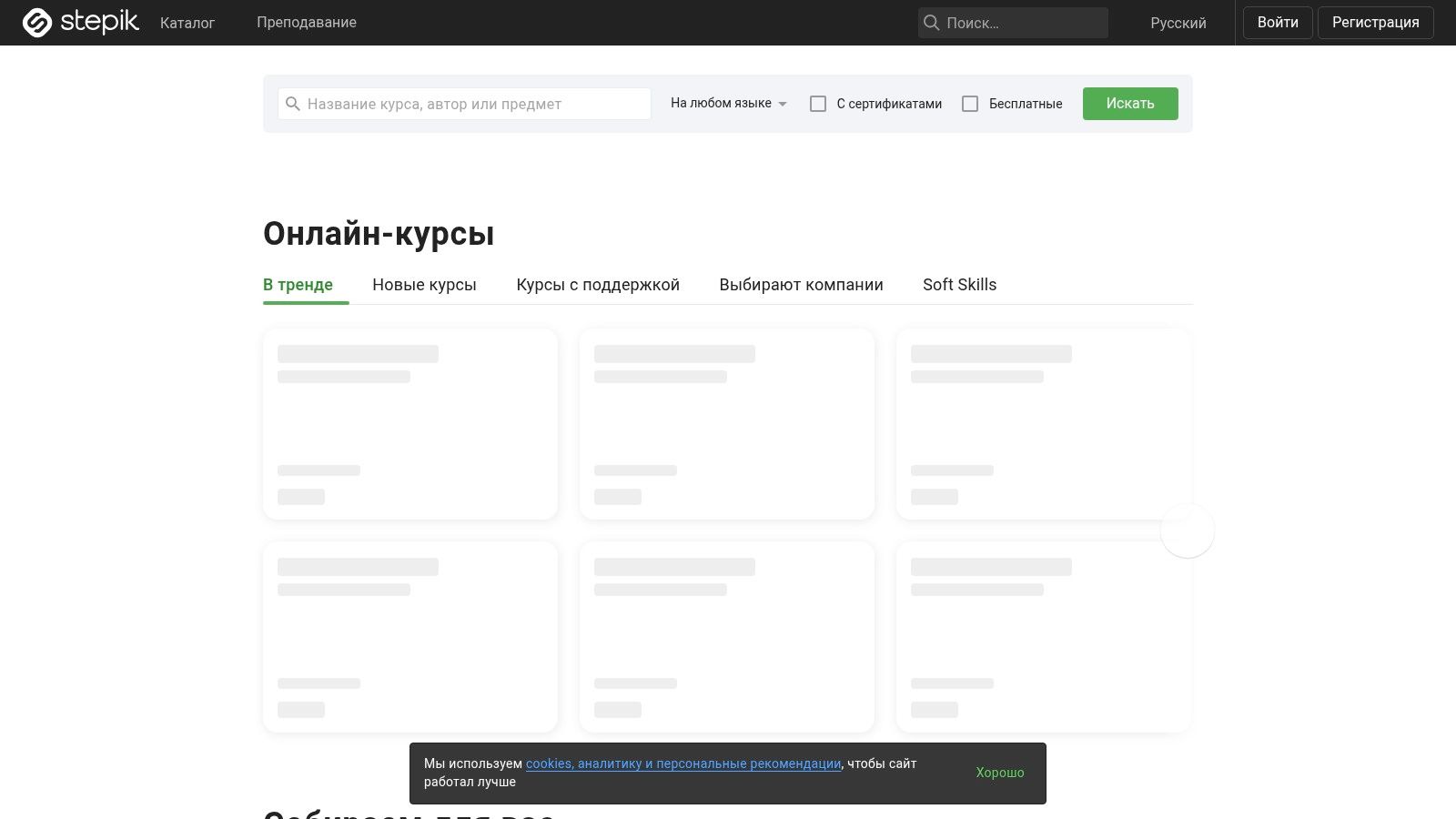
The platform stands out with its integration with JetBrains EduTools, allowing learners to complete coding exercises directly within their IDE for a more practical, hands-on experience. Offering a mix of paid and free courses, Stepik provides flexible learning paths suitable for various budgets and skill levels, making it a noteworthy educational tool for the Russian-speaking Node.js community.
Key Features & Considerations
- RU-Language Instruction: Courses are delivered in Russian, eliminating language barriers for local learners.
- Region-Friendly Pricing: Offers accessible payment options and pricing structures for the local market.
- IDE Integration: Utilises JetBrains EduTools for a seamless, practical coding and learning workflow.
A practical tip for users is to check the course update history before enrolling. While the platform has strong offerings, verifying that the framework versions and content are current ensures the most relevant learning experience.
Website: https://stepik.org/
Top 12 Node.js Frameworks & Resources Comparison
| Item | Core Features / Highlights | User Experience / Quality ★★★★☆ | Value Proposition 💰 | Target Audience 👥 | Unique Selling Points ✨ |
|---|---|---|---|---|---|
| npm | Registry with millions of Node packages | Fast CLI, 2FA, token management | Free, essential for Node ecosystem | Developers, CI/CD pipelines | Single source for Node.js packages 🏆 |
| GitHub | Source code host, CI, discussions | Largest community, Copilot coding aid | Free & paid plans, huge ecosystem | Open-source contributors | Fast access to latest code & PRs ✨ |
| Express | Minimalist web framework, routing, middleware | Stable, widely documented | Free, modular for all app sizes | Web/API developers | De facto standard for HTTP APIs 🏆 |
| NestJS | TypeScript-first, DI, modular architecture | Rich docs, enterprise-ready | Free, official training available | Enterprise, TypeScript devs | Angular-inspired, strong tooling ✨ |
| Fastify | Performance-focused, JSON Schema validation | Excellent speed and logging | Free, growing ecosystem | Performance-critical apps | High throughput with TypeScript support 🏆 |
| Koa | Async/await middleware, minimal core | Clean, modern API | Free, lightweight | Experienced Node devs | Elegant async middleware composition ✨ |
| AdonisJS | Batteries-included MVC, ORM, auth, validation | Rapid, well-documented stack | Free, opinionated | Full-stack TypeScript developers | Cohesive all-in-one backend framework ✨ |
| Sails.js | MVC with Waterline ORM, WebSocket support | Fast prototyping, commercial backing | Free with paid support options | Data-driven app builders | Auto-generated REST & real-time APIs ✨ |
| Meteor | Full-stack, real-time sync, managed hosting | All-in-one, dedicated hosting | Paid tiers available | Rapid prototypers, real-time apps | Push-to-deploy, autoscaling hosting ✨ |
| LoopBack | Model-driven REST/GraphQL APIs | Mature docs & community | Free | API builders needing data control | Strong data connectors & ACLs 🏆 |
| Udemy | Extensive Node.js courses, mobile apps | Varies by instructor, user ratings | Affordable, frequent discounts | Learners & teams | Lifetime access, business plans ✨ |
| Stepik | RU-language Node.js/backend courses | Region-optimized pricing & instruction | Mix of free/paid, refund policy | Russian-speaking learners | JetBrains IDE integration ✨ |
Making the Right Choice for Your Next Project
Navigating the landscape of Node.js frameworks can feel overwhelming, but as we've explored, this rich ecosystem offers a tailored solution for virtually any development challenge. The journey from selecting a minimalist library like Express for a quick MVP to adopting a full-featured framework like NestJS for a complex, enterprise-level system is a testament to the versatility of the Node.js environment. The key takeaway is that the "best" framework is not a universal title but a relative one, defined entirely by your project's specific context.
Your decision-making process should be a strategic evaluation of trade-offs. A framework like Fastify prioritises raw performance, making it an exceptional choice for high-throughput APIs where every millisecond counts. In contrast, AdonisJS or Sails.js offer a more structured, "convention over configuration" approach, which can significantly accelerate development for projects like content management systems or e-commerce platforms by providing a solid, predictable foundation.
Key Factors in Your Decision Matrix
When selecting from the many available Node.js frameworks, it's crucial to look beyond the feature list. Consider these critical factors to ensure your choice aligns with both your immediate needs and long-term vision:
- Project Scale and Complexity: Is this a small microservice or a large-scale monolithic application? Minimalist frameworks excel for the former, while opinionated frameworks provide the necessary guardrails for the latter.
- Team Expertise: What is your team's current skill set? A framework with a gentle learning curve like Koa or Express might be more practical than a TypeScript-heavy one like NestJS if your team is new to these concepts.
- Performance Requirements: For applications where low latency is a critical business requirement, such as real-time bidding or financial data streaming, performance-centric frameworks like Fastify should be at the top of your list.
- Community and Ecosystem: A vibrant community, as seen with Express, means extensive documentation, a wealth of third-party modules on npm, and readily available solutions on platforms like GitHub. This support system is invaluable for troubleshooting and long-term maintenance.
Your Path Forward
The selection of a Node.js framework is a foundational architectural decision that will influence your project's development speed, scalability, and maintainability for years to come. By carefully weighing the strengths and limitations of each option against your unique project goals, you empower your team to build efficiently and effectively. The right choice will not only solve today's problems but also provide a flexible and robust platform for future growth and innovation.
Navigating these technical decisions can be complex. If you need an expert partner to help select and implement the perfect Node.js framework for your business needs, the team at KP Infotech is here to guide you. We specialise in building high-performance, scalable web applications and can help you leverage the right technology to achieve your goals. Visit us at KP Infotech to learn how we can accelerate your digital transformation.