

Customised software, sometimes called bespoke software, is a solution built from the ground up to solve your business's specific problems. Unlike off-the-shelf products that make you change how you work, custom software is built around your unique workflow. It's the difference between buying a suit off the rack and having one tailored just for you.
Understanding Customised Software Without the Jargon

Think of standard software as a rented flat. You can live in it, but you can’t exactly start knocking down walls or changing the floor plan. Customised software is like building your own house from scratch. You get to decide on the number of rooms, where the windows go, and every other detail to perfectly match your lifestyle. This purpose-built approach makes sure the final product solves your exact challenges, without all the extra features that just get in the way.
That distinction is everything. While off-the-shelf software offers a one-size-fits-all solution for a huge audience, it always comes with compromises. You often end up paying for features you'll never touch or finding that critical functions are missing, forcing your team into clunky, inefficient workarounds.
The core idea behind what is customised software is simple: instead of changing your business to fit the software, you create software that supports and improves how your business already works.
Customised Software vs Off-The-Shelf Software at a Glance
Choosing between a custom or pre-built solution will impact everything from your daily efficiency to your long-term ability to grow. It’s no surprise that investment in custom software in the U.S. has shot up, climbing from just 2% of nonresidential fixed investment in 1980 to over 9% in 2023. This shows just how vital it's become.
To make the differences even clearer, here's a quick side-by-side comparison.
| Feature | Customised Software | Off-The-Shelf Software |
|---|---|---|
| Ownership | You own the intellectual property outright. | You only get a licence to use it; you never own it. |
| Functionality | Includes only the features you need, designed for your tasks. | Often bloated with generic features you'll never use. |
| Scalability | Designed from the start to grow alongside your business. | Can become restrictive as your operational needs evolve. |
| Integration | Built to connect perfectly with your other key systems. | Integrations can be limited, difficult, or nonexistent. |
This table lays out the fundamental trade-offs. While off-the-shelf software can get you started quickly, a custom solution is a long-term strategic asset.
Ultimately, customised software is an investment in a tool that gives you a real competitive edge. It perfectly aligns technology with your business goals, offering a level of flexibility and control that pre-packaged alternatives simply can't match.
The Real-World Benefits of a Tailor-Made Solution
Deciding to build a purpose-built solution instead of buying something off the shelf is a big move. The reasons businesses make this investment almost always come down to a few powerful, tangible advantages that directly shape their bottom line and long-term success.
The most immediate payoff is a massive boost in efficiency. Off-the-shelf software makes your team bend their processes to fit its rigid structure. Customised software is the complete opposite; it’s designed to perfectly mirror your ideal workflow, cutting out redundant steps and automating the repetitive tasks that eat up valuable time. This perfect alignment means your team can work faster and with fewer mistakes.
Bespoke software isn't just about adding features—it’s about removing friction. When you build a tool that maps perfectly to your operations, you create a smoother, more intuitive experience for your employees, which directly translates to better productivity.
This efficiency gain is just where it starts. As your business grows, your needs are going to change, and a custom solution is built from the ground up to evolve right alongside you.
Built for Growth and Scalability
One of the biggest traps of standard software is that you can outgrow it surprisingly fast. A tool that’s perfect for a team of five might turn into a serious bottleneck once you hit fifty. Custom software, on the other hand, is architected with your future growth baked right in.
It’s designed from day one to handle more users, more data, and heavier workloads without slowing down. This built-in scalability ensures your software stays a powerful asset, not a technical roadblock you’ll have to rip out and replace in a few years. For a deeper dive, you can explore the full spectrum of the benefits of custom software development in our detailed guide.
Another critical advantage is much stronger security. Since off-the-shelf products are used by thousands of companies, they become a huge, well-understood target for cyberattacks. A single vulnerability can put countless businesses at risk. In contrast, a unique codebase makes your system a far less appealing target, as hackers would have to put in a massive amount of effort just to understand your specific architecture before they could even think about exploiting it.
Creating a Sustainable Competitive Edge
Finally, when you own your software, you own a proprietary asset that your competitors can't just go out and buy. It becomes a key differentiator, allowing you to offer unique services or operate with an efficiency that others simply can't match. This strategic advantage is a major force behind the market's explosive growth.
The India custom software development market is projected to grow at a compound annual rate of 19.76% between 2025 and 2035, ballooning from $2.06 billion to an estimated $15 billion. This surge isn't just a trend; it's a fundamental shift in how successful businesses are building their operational backbones. You can read more on the trends shaping India's custom software market. It shows a clear move towards personalised solutions that deliver a real, distinct competitive edge.
How Custom Software Is Built From Idea to Launch
Bringing a custom application to life isn't about some black box of code. It's a structured journey, a clear and collaborative path that takes an idea from a simple concept to a fully functioning reality. It all starts with a deep dive into your business goals, making sure the final product is a perfect match for your vision.
That initial discovery and planning phase is probably the most important part of the entire process. This is where developers and business analysts sit down with you to really get to grips with your challenges, map out how you work now, and define the exact problems the new software needs to solve. The result is a detailed blueprint that lays out every feature, technical requirement, and the overall scope of the project.
Once that blueprint is locked in, the real design and development work can begin. This is where your vision starts to become something you can see and touch.
Designing and Developing the Solution
First up, the team tackles the User Interface (UI) and User Experience (UX). Designers will create wireframes and mockups, essentially sketching out how people will interact with the software. The focus here is on making everything intuitive, efficient, and dead simple to navigate. After all, a powerful tool is useless if nobody can figure out how to use it.
With the design approved, the developers roll up their sleeves and get to the core coding. This is usually the longest phase, where programmers write the actual code that breathes life into the features. They'll build out the database, develop the application's logic, and connect all the different pieces together. To get a more detailed look at how these steps flow, you can explore a complete software development life cycle example.
This infographic gives you a simplified look at the core development process.
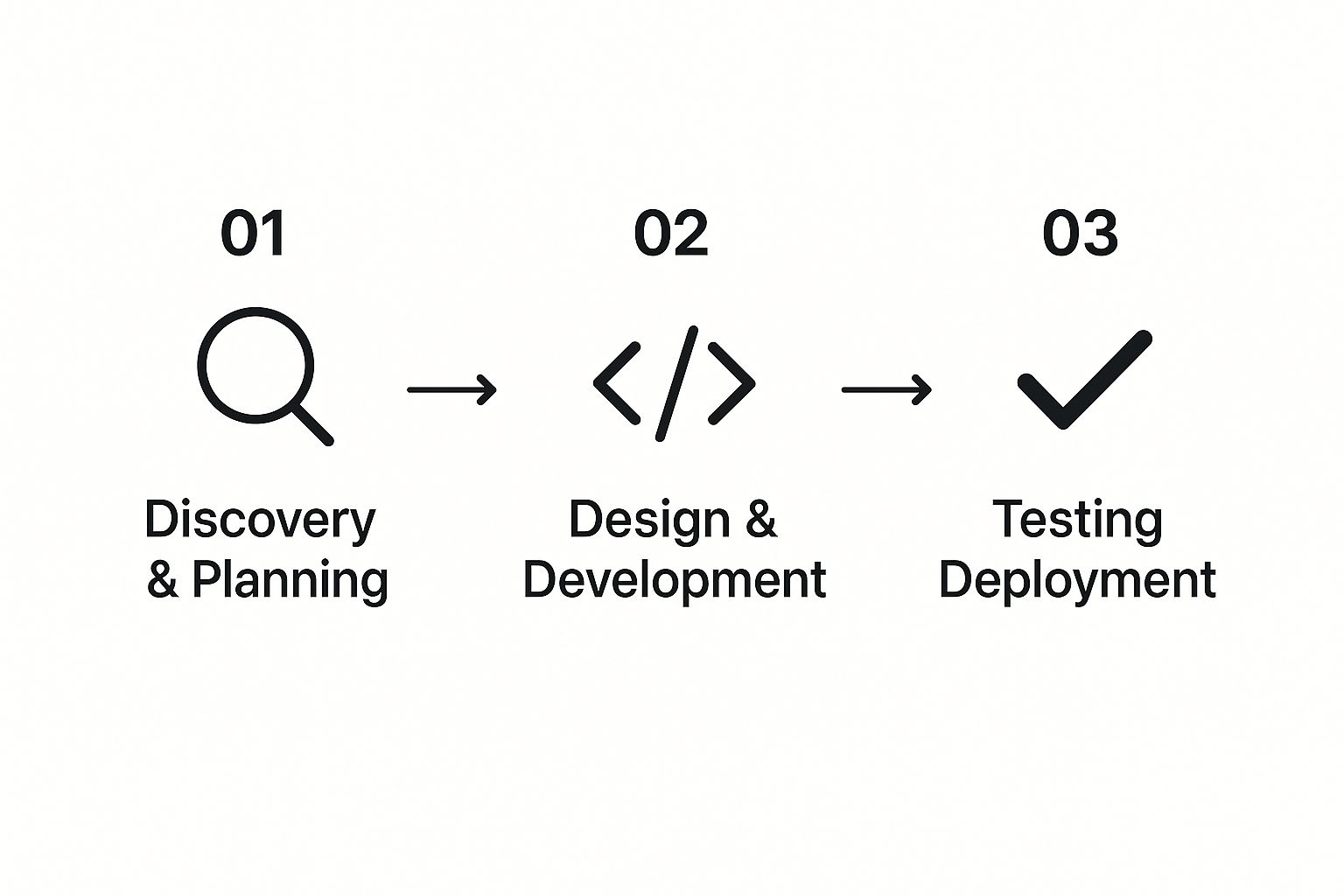
As you can see, each stage builds logically on the one before it, moving from initial strategy right through to the final launch. For custom software to stay flexible and easy to maintain down the line—especially as teams change or new features get added—it's vital to build it on a solid foundation, which includes following code documentation best practices.
Testing and Launching the Product
Once the first version is built, the software moves into a tough testing and quality assurance (QA) phase. Testers go through every single feature with a fine-tooth comb, trying to find and fix bugs, make sure the application is secure, and confirm it can perform reliably under pressure. This stage is absolutely crucial for delivering a polished, professional product that just works.
Finally, after all the bugs are squashed and the software ticks all the boxes, it’s time for deployment. The application goes live and is rolled out to your users. But the work doesn't stop there. Post-launch support and maintenance are just as important for keeping the software running smoothly, applying necessary updates, and making smart improvements based on real user feedback.
Seeing Customised Software in Action

It’s one thing to talk about what customised software is in theory, but its real power clicks into place when you see it solving actual, everyday business headaches. These purpose-built applications aren’t just lines of code; they’re the engines that drive real growth and smooth out operational bumps across almost every industry you can think of.
Let’s look at a concrete example. Imagine a logistics company struggling with messy delivery routes. Their drivers are burning fuel in traffic jams, and unpredictable delivery times are making customers unhappy. A standard, off-the-shelf mapping app gives them generic directions, but it has no idea about the company's specific fleet size, tight delivery windows, or the real-time capacity of each truck.
A custom-built logistics platform, on the other hand, can completely change the game.
A purpose-built system can analyse live traffic data, vehicle availability, and delivery priorities to calculate the most efficient routes in real-time. This isn't just a map; it's a dynamic operational brain that cuts fuel costs, improves on-time delivery rates, and boosts overall profitability.
This is exactly what makes customised software so valuable: it takes a messy, industry-specific challenge and turns it into a streamlined, automated process. And that same logic applies pretty much everywhere.
Solving Unique Industry Challenges
The applications for bespoke software are nearly endless, simply because every industry has its own unique set of operational hurdles. A generic, one-size-fits-all solution rarely gets to the heart of these specific pain points.
- Financial Services: A wealth management firm could commission a custom compliance dashboard. This tool would automatically track regulatory changes, flag potential risks in client portfolios, and generate complex reports, drastically reducing manual errors and ensuring adherence to strict legal standards.
- E-commerce: An online fashion brand might develop a platform with an AI-powered recommendation engine. By analysing customer behaviour, the system can suggest products with remarkable accuracy, leading to a significant increase in average order value and fostering stronger customer loyalty.
- Healthcare: A hospital could implement a bespoke patient management system. This software would integrate appointment scheduling, electronic health records, and billing into a single, secure platform, improving patient care coordination and administrative efficiency.
These examples show how businesses can hit strategic goals by investing in technology that fits them perfectly. This trend is a major driver of India's broader software market, which was valued at $21.1 billion and is projected to reach approximately $61.5 billion by 2033. This growth is fuelled by widespread tech adoption and government initiatives like 'Digital India', which encourage the creation of specialised solutions across key sectors. You can discover more insights about India's software market on imarcgroup.com.
Here’s a quick look at how different industries put custom software to work.
Custom Software Applications by Industry
This table highlights a few examples of how different sectors leverage customised software to solve specific operational challenges and drive growth.
| Industry | Example Application | Key Business Benefit |
|---|---|---|
| Manufacturing | A real-time inventory and supply chain management system | Reduces waste, prevents production bottlenecks, and improves forecasting accuracy. |
| Retail | A customer loyalty app with personalised offers and rewards | Increases customer retention, boosts repeat purchases, and provides valuable sales data. |
| Real Estate | A custom property management platform for agents and landlords | Streamlines rent collection, automates maintenance requests, and centralises communication. |
| Education | An e-learning portal with interactive modules and progress tracking | Enhances student engagement, simplifies remote learning, and offers personalised study paths. |
These examples just scratch the surface, but they clearly show how a tailored solution can deliver a direct and measurable return on investment.
Ultimately, seeing customised software in action reveals its true identity. It’s not just tech for tech's sake; it’s a strategic asset designed to solve the exact problems your business faces today and to provide the flexibility you need to take on the challenges of tomorrow.
Finding the Right Partner for Your Software Project

Your software idea is only half the battle; the team you choose to bring it to life is the other half. Picking the right development partner is probably the most important decision you’ll make. Their skill, communication, and approach will directly shape whether your project sinks or swims.
This is about more than just finding people who can write code. You're looking for a genuine strategic partner who gets what you’re trying to achieve with your business. A great team doesn't just build what you tell them to—they guide you, poke holes in your ideas, and offer expert advice to make sure the final product actually delivers real value. Their ability to translate your business needs into a functional, intuitive application is what separates a mediocre outcome from a truly successful one.
Finding the right partner means finding a team that is as invested in your success as you are. They should be just as focused on your business goals—like boosting efficiency or growing sales—as they are on writing clean code.
Key Criteria for Vetting Potential Partners
When you start talking to potential development teams, you need to look past the slick sales pitch and dig into the nitty-gritty of their experience and processes. A solid vetting process will help you find a partner that’s a great fit both technically and culturally.
First, take a hard look at their portfolio and technical chops. Have they built anything like your project before? Do they have any experience in your industry? A team that already understands the unique quirks and challenges of your market will get up to speed way faster and offer much more relevant advice.
You also need to understand how they work. Most modern teams follow Agile or Scrum frameworks, which are all about flexibility, collaboration, and constant communication. This iterative style lets you give feedback at every step, making sure the project stays on track and aligned with what you actually need. And don't forget to ask about what happens after launch—support and maintenance plans are not an afterthought.
Essential Questions to Ask a Development Team
To help you make a smart decision, here are a few critical questions you should ask every single team you consider:
- Can you show us case studies of similar projects you've completed? This is the best way to verify their experience and get a feel for the quality of their work.
- How will you handle project management and communication? You’re looking for transparency, regular check-ins, and a clear point of contact.
- What is your process for testing and quality assurance? A robust testing strategy is non-negotiable if you want a reliable, bug-free product.
The intense demand for skilled developers really underscores how crucial this choice is. India, for example, expects over 2 million new tech job openings annually in fields tied directly to custom software, with demand for AI specialists soaring by 170%. This shows a massive industry shift towards specialised talent capable of building sophisticated solutions. You can find out more about the software development job market in India at muneebdev.com. Partnering with a team that has proven expertise in these high-demand areas ensures your project is built with modern, effective technology.
Is Custom Software the Right Move for Your Business
A bespoke solution is a powerful tool, but it’s not always the right answer. Deciding if customised software is a smart investment requires taking a hard look at your daily operations, your future goals, and the very real limits of off-the-shelf products. The whole game is about weighing the upfront investment against the long-term return.
Start by looking at your core processes. Are your teams bogged down by clunky workarounds or constantly juggling multiple, disconnected apps just to get a single job done? If off-the-shelf software is forcing you to bend your workflow to fit its rules, that friction is a constant drain on productivity. It's also a huge red flag that a custom solution could unlock some serious efficiency.
Next, think about your growth plans. A pre-built tool might do the job today, but will it be able to keep up with you over the next five years?
A custom solution is an asset built for your future. It's designed to adapt and grow right alongside your business, preventing you from hitting a technological wall that forces a costly replacement down the line.
Making an Informed Decision
Finally, you have to look at the total financial picture. While the upfront price tag is a major factor, it’s crucial to look beyond that initial number. When you’re weighing the options, remember that adopting legacy system modernization strategies often leads to tailor-made solutions that more than pay for themselves over time.
You need to calculate the potential ROI from:
- Increased Efficiency: How much time and money will you actually save by automating tedious tasks and smoothing out your workflows?
- Greater Scalability: What’s the real cost of being held back by software that can’t keep up with your growth?
- Market Differentiation: Can a unique software asset give you a competitive edge that helps you attract and keep more customers?
By stacking these long-term benefits against the initial build cost, you can make a confident, data-driven decision. To get a better handle on the financial side, digging into a detailed breakdown of custom software development costs can bring a lot of clarity. This will help you figure out if a bespoke solution is the key to unlocking your business’s full potential.
Frequently Asked Questions About Customised Software
As you start exploring what customised software can do for you, a few practical questions are bound to come up. Getting clear answers on the investment, timeline, and ownership is essential for feeling confident before you move forward. Let’s tackle some of the most common ones.
How Much Does Customised Software Cost?
This is always the first question, and for good reason. The honest answer is a bit like asking, "How much does it cost to build a house?" A simple app is like a small cottage, while a complex enterprise platform is a sprawling mansion.
The final price tag isn't a single number but is shaped by a few key factors:
- Project Scope and Complexity: This is the biggest driver. The number of features you need, how intricate the business logic is, and whether you need it on web, Android, and iOS all play a huge role.
- Technology Stack: The specific programming languages and frameworks we use can influence the cost, especially if they call for highly specialised skills.
- Third-Party Integrations: Need your new software to talk to your existing CRM, payment gateway, or accounting tools? Connecting these systems adds to the complexity and cost.
- Team Size and Location: The number of developers, designers, and testers on the project, along with their location, will naturally factor into the overall budget.
A small, focused project might start in the low thousands, but large, sophisticated systems can easily run into six figures and beyond. The key is to get a detailed quote based on a very clear scope of work.
How Long Does Development Take?
Just like cost, the timeline is tied directly to the project's complexity. A simple Minimum Viable Product (MVP) with just the core features could be up and running in 2-4 months.
A more comprehensive application with advanced features and several integrations might take closer to 6-9 months. Truly large-scale enterprise systems can take a year or even longer to build right.
A good development partner will break the project into phases or sprints, delivering functional pieces of the software regularly. This approach allows you to provide feedback and ensures the project stays on track and aligned with your goals.
Do I Own the Source Code?
This is a critical question, and the answer should always be a firm, unequivocal yes.
When you commission customised software, you're paying for the creation of a business asset. Your agreement with your development partner must clearly state that you own 100% of the intellectual property (IP) and the source code once the final payment is made.
Without full ownership, you're essentially just renting the software. You'd be locked in with the original developer for every future update or change. Owning the code gives you the freedom to modify, scale, and maintain your application with any team you choose, protecting your investment for the long haul.
Ready to build a software solution that fits your business perfectly? The expert team at KP Infotech designs and develops high-performance custom applications that drive efficiency and growth. Start your project with us today.